The 2026 State of the Global Workplace report is out. And somewhere in a boardroom near you, someone is reading this sentence and quietly nodding:
“The strongest predictor of AI adoption is whether the direct manager actively champions it – and many employees report a lack of active support from their managers.”
$40 billion in enterprise AI investment. 95% of organizations with zero measurable profit impact. 89% of global executives reporting no effect on labor productivity.
And the answer the data points to – is the manager.
Before we accept that conclusion, let’s actually think about who that manager is. And how they got there.
We gave them one door and called it a choice.
In most organizations, there is no meaningful career progression that doesn’t run through people management. You want better compensation? Become a manager. You want to be taken seriously at the senior table? Lead a team. You want a title that signals ambition? Manage people.
So the system funneled in brilliant individual contributors – people who were exceptional at doing – and handed them a role that requires something categorically different. Not better execution. A complete identity shift. From personal output to collective enablement. From being the expert to developing others. From doing the work to creating the conditions for work to happen.
That shift is genuinely hard. It requires training, time, and an environment where you can afford to get it wrong while you’re learning.
Most received none of that.
And many never actually made the shift.
A significant portion of today’s management layer is technically called managers – but mentally, behaviorally, and emotionally still operating as senior individual contributors. They’re doing the work instead of enabling it. They’re avoiding the hard people conversations because nobody taught them how to have them, especially in a diverse environment. They’re measuring their value by their own output, because that’s the only measurement system they were ever given.
So they sit – compressed from above by leadership expectations they were never equipped to translate, and from below by teams that are disengaged, fragmented, and increasingly cross-cultural in ways that demand a sophistication nobody developed in them.
Not a bridge. A wall under pressure.
And here is what makes this particularly cruel: the modern team is not the team of a decade ago. Today’s managers are leading across generations that have fundamentally different relationships with authority, feedback, and work itself. Across cultures where psychological safety, directness, and collaboration mean different things. Across lived experiences that shape how people hear criticism, ask for help, or signal that they’re struggling.
That’s not a diversity checkbox. That’s a complex human capability that takes years to build -and that most managers were never given the language, the framework, or the space to develop.
And then came the burnout. And with it, the end of learning.
Gallup’s data shows managers report higher daily stress, more anger, more sadness, more loneliness than the individual contributors they lead – while being less likely to say they laughed or felt enjoyment the previous day.
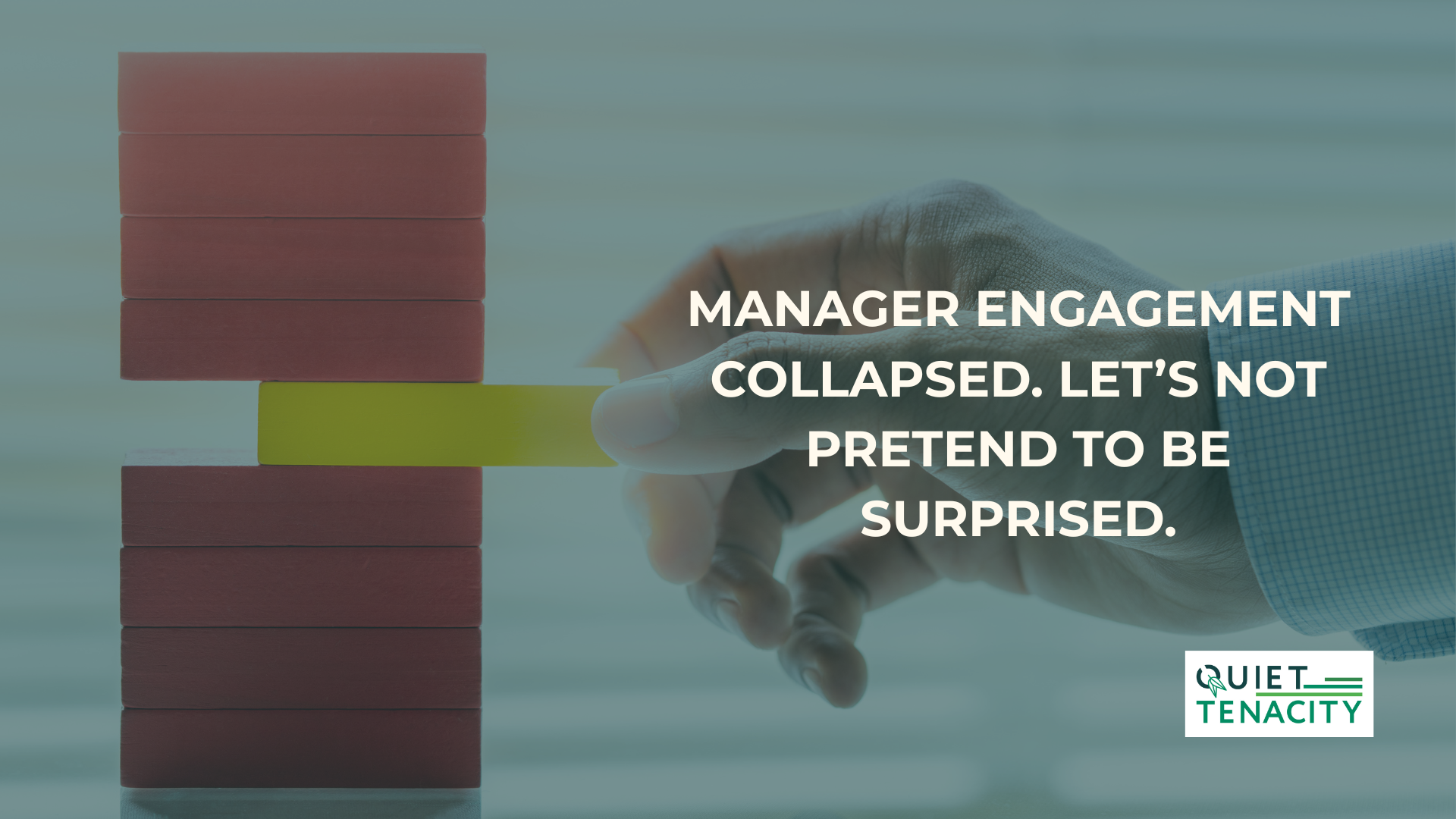
Manager engagement has dropped nine points since 2022 – from 31% to 22%. Five of those points were lost in a single year, between 2024 and 2025 alone.
These are not people who stopped caring. These are people who have been running on empty for long enough that the tank isn’t just low – the engine is different now. Burnout doesn’t just drain energy. It degrades cognitive capacity, shrinks tolerance for ambiguity, and closes off the curiosity that learning requires.
You cannot develop someone who is in survival mode. You cannot build cultural fluency, coaching skills, or cross-generational leadership capability in someone who is managing their nervous system just to get through the week.
And yet that is precisely the moment most organizations choose to send the training invitation.
So here is what we actually have.
A generation of people who were never really managers, who never fully became managers, who are now too depleted to become managers – and we keep treating this as a performance problem instead of a design problem.
We hear this directly. Most of the clients in our coaching program are managers – many are internationally educated professionals who built careers across borders, navigated new systems, learned new rules, and worked twice as hard to be taken seriously. And what they tell us, consistently, sounds like this:
“I took on the team because I wanted promotion, I wanted to grow. And there was no other way. And now instead of doing the work I actually love, I spend my days managing up, managing down, and trying to hold it all together. The training doesn’t help – it’s not built for what I’m actually dealing with. I don’t have time to read. I don’t have time to reflect. I’m just surviving.”
That is not a person failing at management. That is a person the system failed before they ever had a real chance.
The data makes the contrast impossible to ignore.
In best-practice organizations – the ones that genuinely invested in their management layer – 79% of managers are engaged. What Gallup itself calls nearly quadruple the global average. And that number held steady while the rest of the world’s management layer collapsed.
People with similar roles. Completely different systems built around them.
The report is not wrong that managers are the critical variable. It just pointed the accountability in the most convenient direction – toward the individual, and away from the architecture that produced them.
This isn’t a manager problem.
It’s what happens when organizations design a pipeline, skip the investment, and then point at the output and ask why it isn’t working.
But fixing it doesn’t mean cutting management layers further. It means less volume and more intention.
Fewer people pushed into management because it was the only door open to them. More people who choose it – genuinely choose it – with a clear understanding of what it actually entails. Not the title. Not the pay grade. The real work. The emotional labor. The complexity of leading humans across cultures, generations, and lived experiences that don’t resemble your own.
And for the ones who don’t want that – who are exceptional at what they do and should be allowed to stay exceptional at it – a real path. With real compensation. With real status attached to it. Not a consolation track.
This is a two-way street. Organizations need to build the systems, the career architectures, and the genuine development infrastructure that makes good management possible. And people stepping into these roles need the self-awareness to understand what they’re actually signing up for – and the support to grow into it once they do.
Thank you for reading.
Kindly, Inna