
(No, that’s not a typo — it’s intentional branding.)
Over the past few years, professional spaces have become far more comfortable talking about storytelling. We encourage people to share their authentic selves. We ask leaders to communicate through story. We design workshops on narrative and personal voice. We invite employees to share experiences, and we frame storytelling as a bridge to empathy, trust, and inclusion.
And yet, in many of those same spaces, people feel profoundly unheard.
Not unseen in the abstract. Not excluded in the procedural sense. Unheard in the more difficult, more intimate, and more consequential sense: they do not feel that their experiences are being received with enough patience for meaning to fully emerge. They may be given room to speak, but not enough room to unfold. They may be listened to politely, but interpreted too quickly. They may be welcomed into the conversation, but only insofar as their stories arrive in familiar language, on familiar timelines, and in a form that can be easily translated into action.
That contradiction has been on my mind a great deal since the truly exceptional Cannexus 2026 conference by CERIC, where I had the honour of presenting and holding space for discussion on the topic of Cultural Curiosity

The gap is not expression. The gap is reception.
Listening is often treated as a soft skill, almost a personality trait. Some people are “good listeners”; others are not. In leadership language, listening is often framed as presence, attentiveness, or emotional intelligence. Those qualities matter, but they do not go far enough. They do not account for the ways listening itself is shaped by institutional culture.
Most professionals are not taught to listen for emergence. They are taught to listen for relevance.
They are trained to extract the issue, identify the obstacle, assess the risk, determine the action, and keep things moving. This is especially true in environments that reward decisiveness, efficiency, and executive presence — particularly in Westernized workplace environments. Under those conditions, quick interpretation begins to look like competence. Fast response begins to look like care. Ambiguity starts to feel inefficient. Pausing to sit with a story before deciding what it means can feel indulgent, unfocused, or professionally weak.
So the story gets interrupted, not necessarily with rudeness, but with urgency. Context gets compressed. Meaning gets flattened. What does not fit existing categories gets overlooked. And what requires more time than the system comfortably allows often disappears altogether.
This is not usually the result of cruelty. More often, it is the result of cultural habit

Cultural Curiosity goes beyond Nationality and Ethnicity
What I noticed in the room was revealing. When the conversation turned to culture, many people still instinctively understood that word through the narrow frame of ethnicity or nationality. That is not surprising. It is one of the most common limitations in workplace conversations about culture. Culture is still too often treated as something visible, external, or attached primarily to heritage, rather than as a broader system of meaning that shapes how people relate to pretty much everything in professional life: time, conflict, authority, belonging, professionalism, directness, recognition, silence, uncertainty, and success.
But as soon as we realize that culture is everywhere and in everything, the energy shifts, and stepping into a state of curiosity becomes more relevant and meaningful on a personal level. The conversations become more engaged, more expansive, more alive. People begin making connections. They suddenly see culture in places where they had not been trained to notice it before.
This is one of the reasons I so strongly believe that cultural curiosity is learnable. It is not simply a personality trait that some people possess and others do not. It is a discipline. A posture. A capability that can be strengthened when people are invited to move beyond instinctive interpretations and stay with complexity a little longer.
Some of the most meaningful learning I experienced at the conference happened in the flow of the event itself, in conversations that were unhurried, contextual, relational, and not overly packaged for outcome. In particular, exchanges with the career professionals representing Indigenous communities stayed with me, not because they were framed as “takeaways,” but because they modelled a different quality of listening. Nothing was being rushed into a conclusion. Nothing needed to be turned immediately into a lesson. Meaning emerged through presence, timing, and relational attentiveness.
That kind of listening is increasingly rare in professional life.
Not because people do not value it in theory, but because many of the workplaces we work within are not built to sustain it.
The Deeper Pattern: Lack of Patience
We rush toward action. We rush toward solutions. We rush toward labels, summaries, frameworks, and interventions. Even in spaces committed to reflection, there is often an undercurrent of impatience: What is the point? What is the takeaway? What should we do with this?
Those are not bad questions. In fact, they are often necessary. But asked too early, they alter the story before the story has had a chance to reveal itself.
I am less interested in blaming social media or modern attention spans, though those factors may play some role. The more significant force, in my view, is professional culture itself. Contemporary workplaces reward the appearance of clarity. Leaders are expected to move, decide, respond, and resolve. Indecisiveness is tolerated only briefly. Slowness has to justify itself. Interpretation happens fast, often before observation is complete.
This has consequences

I keep coming back to this: conflict that could have been productive, developmental, even transformative often never ends positively because it is not understood deeply enough to move. It freezes in time. People give up on being known. They simplify themselves to survive the interaction. Or they take their real interpretations somewhere else: to friends, to coaches, to consultants, to family, to private group chats, to spaces outside the organization where they feel less managed and more genuinely heard.
This is one reason I am increasingly cautious when organizations speak confidently about psychological safety.
Many organizations believe they have created it. They may even have the right policies, language, and intentions in place. But if people consistently go elsewhere to have their most honest conversations, then something important must be examined. Safety may have been declared, but not experienced. Inclusion may have been signalled, but not metabolized. Listening may be performed, but not deeply practiced.
There is a difference between creating opportunities for people to speak and creating conditions in which their stories can actually alter understanding.
The second is much harder.
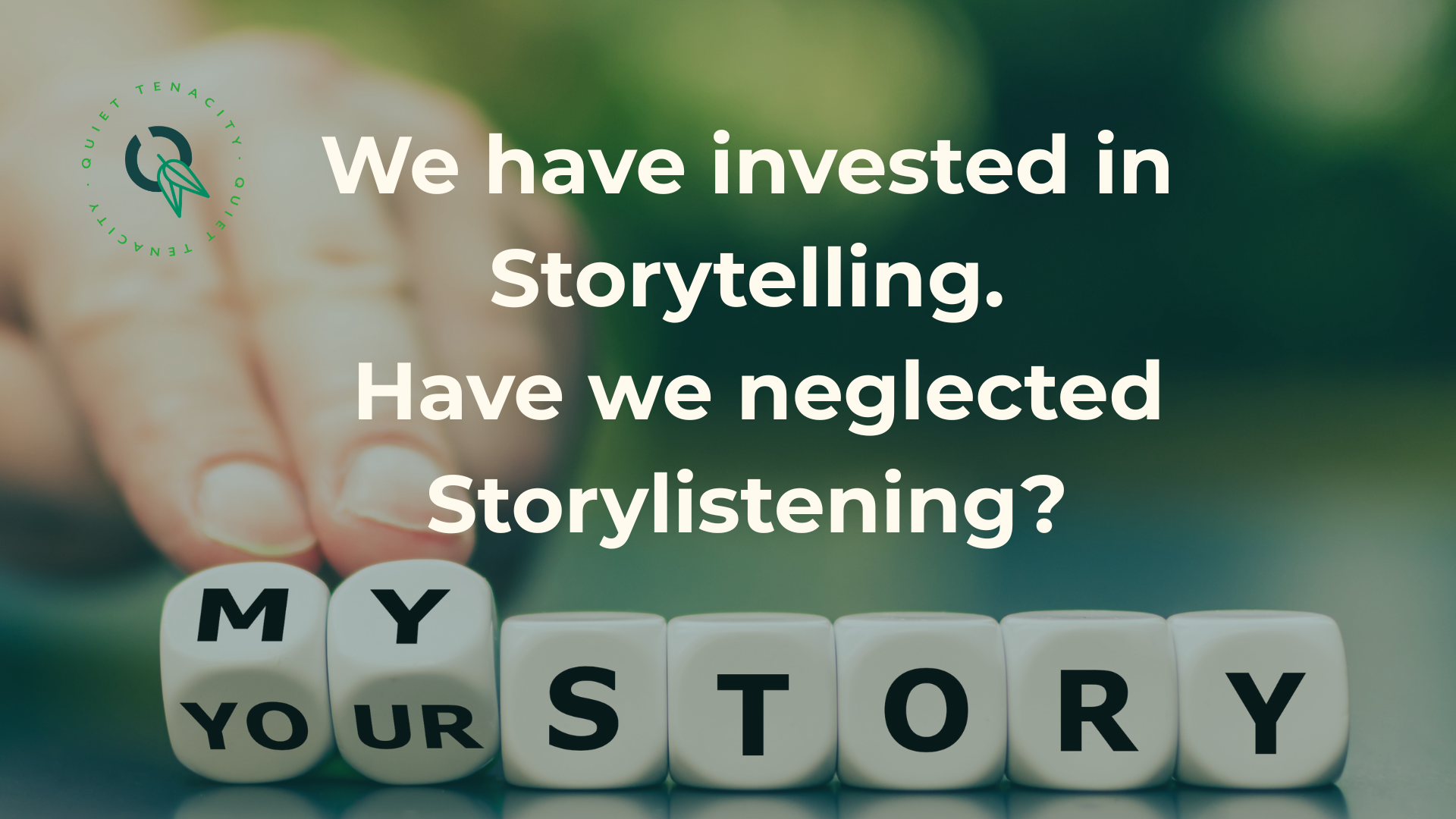
Storylistening is not passive. It is Interpretive Discipline.
Part of the problem, I think, is that listening is often imagined too narrowly. We picture it as a conversational act: asking questions, maintaining eye contact, not interrupting, showing empathy. All of that matters, but cultural story listening goes further.
It requires a person to enter a different state.
It requires holding assumptions long enough for other meanings to become possible. It requires resisting the temptation to treat visible behaviour as self-evident truth. It requires tolerance for ambiguity and a willingness to remain in that ambiguity without panicking into premature certainty. It requires humility about one’s own interpretive habits.
Most importantly, it requires recognizing that time itself is not neutral.
People do not all arrive at trust on the same timeline. They do not process conflict at the same pace. They do not reveal meaning in the same sequence. What appears evasive to one person may be thoughtful to another. What appears slow may, in fact, be careful. What appears emotionally restrained may carry deep significance. What appears overly direct may be an attempt at honesty rather than aggression. Without cultural curiosity, these differences are often misread through a narrow professional norm and then turned into judgments about competence, attitude, readiness, or fit.
This is why cultural storylistening is not passive empathy. Nor is it silent caution. It is not the avoidance of saying the wrong thing. It is not surface-level politeness. And it is certainly not the assumption that anything visible tells the full story.
It is an active form of interpretive discipline.
It asks, in essence: What else could this mean? What might I be missing because I am reading this too quickly? What context would need to be true for this person’s way of speaking, pausing, disagreeing, withholding, or showing up to make sense on its own terms?
This is difficult work. It is also deeply practical work.
Listening is not only conversational. It is observational.
Another reason storylistening remains underdeveloped is that many leaders assume it happens only when someone is explicitly sharing a story. But some of the most important listening in organizational life is observational rather than verbal.
It happens when someone notices who speaks easily and who rarely speaks at all. It happens when a leader observes whose ideas are ignored until repeated by someone else. It happens when discomfort in one person is interpreted as resistance, while the same behaviour in another is read as conviction. It happens when one begins to notice the absence of certain voices, not merely the presence of loud ones.
This kind of listening is less about emotional warmth and more about pattern recognition. It is sense-making. It is the ability to detect that something in the social fabric is not being accurately read, even when nobody has fully named it yet.
In that sense, cultural storylistening belongs much closer to strategic leadership than many organizations currently assume.
It is not ornamental. It is diagnostic.
Fear Is Reshaping How People Engage Across Difference
There is one more layer here that deserves careful treatment.
In recent years, many people have become more aware of microaggressions, bias, harm, and the unintended impact of language. That awareness has been necessary. It has created vocabulary for experiences that were previously minimized or dismissed.
At the same time, another pattern is also emerging: fear is making many people more avoidant.
Some leaders and colleagues are becoming so afraid of saying the wrong thing, asking the wrong question, or being interpreted as insensitive that they retreat from real engagement altogether. Not always consciously. Sometimes the retreat is subtle. Curiosity narrows. Conversation becomes overly scripted. Interactions become safer on the surface, but thinner underneath. People speak more carefully, but not more courageously. They remain polite, but less connected.
This is a delicate point, because it must be handled without minimizing the reality of harm. But it matters.
The answer to that fear cannot be recklessness. It also cannot be silence.
The answer, I believe, is cultural curiosity mature enough to remain present without certainty. Curious enough to ask with care. Humble enough to be corrected. Grounded enough not to collapse under the discomfort of imperfection. Skilled enough to distinguish between harmful carelessness and the vulnerable, necessary messiness of real human engagement.
If we do not build that capacity, more and more workplaces will drift into a sterile kind of coexistence: low-risk, low-trust, and low-depth.
Why this matters now
I do not think we are dealing here with a small communication issue.
For all our language about connection, many people are becoming less practiced in the conditions that make real understanding possible. We are speaking more about voice and less about reception. We are building frameworks for expression while neglecting the slower work of interpretation. We are treating listening as basic when, in fact, it may be one of the most advanced capabilities required in a diverse and rapidly changing society.
And in Canada especially, this matters.
Diversity here is a lived reality that shapes professional life every day. People are navigating different relationships to authority, self-promotion, directness, feedback, hierarchy, conflict, community, and time. They are working across visible and invisible differences. Under those conditions, cultural curiosity is not an accessory to professionalism. It is part of professionalism.
Without it, people will continue hearing one another through narrow frames, misreading one another with confidence, and calling the result misunderstanding, resistance, or poor fit.
With it, something more hopeful becomes possible.
Not perfect understanding. Not instant harmony. But the ability to stay with one another long enough for better meaning to form.
That, to me, is the beginning of wiser workplaces.
Thank you for reading. Kindly, Inna
****
Quiet Tenacity Inc is an independent workforce-enablement and training provider helping organizations strengthen the human-power skills their employees need to navigate change, difference, and collaboration at work. Reach out to learn more.